
Dividend Deep Dive: From Zero Payout to Nigeria’s Most Valuable Bank
FirstHoldCo (FIRSTHOLDCO) Dividend Deep Dive: From a Wipeout Year to Nigeria’s Most Valuable Bank
By PaprSwing Desk
A year ago, FirstHoldCo shareholders were staring at a profit line gutted by loan-loss provisions and, by several accounts, a financial year that closed without the dividend they were used to. Today the same company has overtaken Zenith Bank as Nigeria’s most valuable listed lender, its chairman has been buying shares by the billion, and the board just approved one of the most generous dividend policies in Nigerian banking history. That is not a small swing, and it is exactly the kind of number that deserves an audit-grade look before anyone gets excited about the yield.
This deep dive works through FirstHoldCo’s three-year dividend and earnings history, explains the anomaly sitting in the middle of that history, and puts the new 60%-of-profit dividend policy in context — including what it could realistically mean for the payout on a per-share basis.
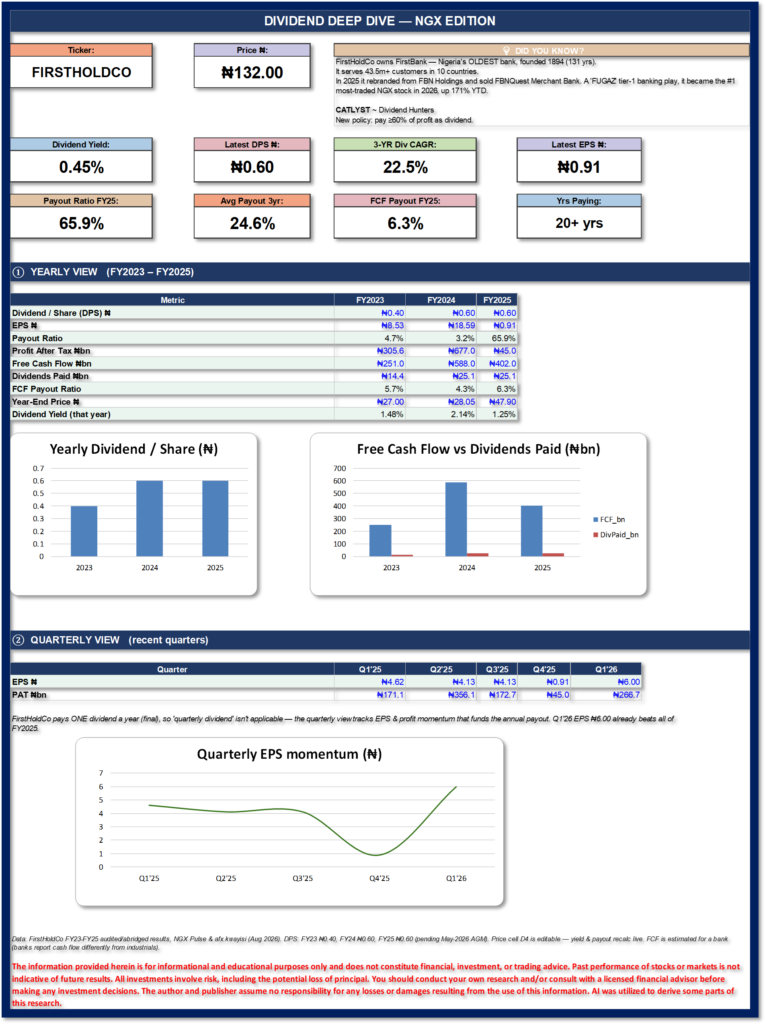
Snapshot: FIRSTHOLDCO at a glance
| Metric | Value |
|---|---|
| Ticker | FIRSTHOLDCO |
| Reference price | ₦132.00 |
| Trailing dividend yield | 0.45% |
| Latest DPS | ₦0.60 (FY2025, pending May-2026 AGM ratification) |
| 3-year dividend CAGR | 22.5% |
| Latest annual EPS | ₦0.91 (FY2025) |
| FY2025 payout ratio | 65.9% |
| 3-year average payout ratio | 24.6% |
| FCF payout ratio (FY2025, estimated) | 6.3% |
| Years of consecutive dividend payments | 20+ |
Data: FirstHoldCo FY2023–FY2025 audited/abridged results, NGX Pulse and afx.kwayisi (as of August 2026). The FY2025 dividend of ₦0.60/share was pending shareholder approval at the May 2026 AGM at the time of the source data.
The 131-year backstory behind the ticker
FirstHoldCo is the holding company that owns FirstBank of Nigeria, a lender that traces its roots to 1894 — older than most banks anywhere on the continent, and founded decades before Nigeria itself existed as a country. FirstBank now serves more than 43 million customers across roughly ten markets, spanning West Africa and outposts in the UK, France and China. In 2025 the parent company dropped the “FBN Holdings” name it had carried since adopting the holding-company structure in 2012 and rebranded as First HoldCo Plc, a move the group said was meant to unify its banking, merchant banking, asset management and insurance businesses under one identity. As part of that same restructuring period, the group also exited FBNQuest Merchant Bank.
FirstHoldCo sits alongside GTCO, Zenith Bank, Access Holdings and UBA in the “FUGAZ” group — the informal shorthand investors use for Nigeria’s five tier-1 banking names. It is also, as of the most recent data, the single most actively traded stock on the NGX, up roughly 171% year-to-date.
The dividend story, year by year
| Metric | FY2023 | FY2024 | FY2025 |
|---|---|---|---|
| Dividend per share | ₦0.40 | ₦0.60 | ₦0.60 |
| EPS | ₦8.53 | ₦18.59 | ₦0.91 |
| Payout ratio | 4.7% | 3.2% | 65.9% |
| Profit after tax | ₦305.6bn | ₦677.0bn | ₦45.0bn |
| Free cash flow (est.) | ₦251.0bn | ₦588.0bn | ₦402.0bn |
| Dividends paid | ₦14.4bn | ₦25.1bn | ₦25.1bn |
| FCF payout ratio | 5.7% | 4.3% | 6.3% |
| Year-end share price | ₦27.00 | ₦28.05 | ₦47.90 |
| Dividend yield (that year) | 1.48% | 2.14% | 1.25% |
Two things jump out of this table, and they pull in opposite directions.
The good news first: the dividend per share itself has grown at a 22.5% three-year CAGR, and FirstHoldCo has now paid a dividend for more than 20 consecutive years — a genuinely rare streak on the NGX, where dividend continuity through the 2016-2017 recession and the 2020 pandemic weeded out plenty of “reliable” payers.
The number that needs an explanation: EPS collapsing from ₦18.59 in FY2024 to ₦0.91 in FY2025 — a roughly 95% drop — while the payout ratio simultaneously spiked to 65.9%, well above the three-year average of 24.6%. On the surface, a bank paying out two-thirds of a near-vanished profit line looks like a red flag.
What actually happened to FY2025 profit
This is where the deep dive earns its name, because the headline payout ratio is misleading without context. FY2025 was, by multiple market reports, the roughest year in FirstHoldCo’s recent history: a large loan-loss provision — tied to the cleanup of legacy non-performing exposures — took a sledgehammer to profit after tax, and shareholders reportedly went without a dividend that year for the first time in a long while, a fate FirstHoldCo shared with peers Access Holdings and UBA, who were also constrained by regulatory capital considerations. The ₦0.60 dividend attached to FY2025 in the data above reflects a subsequent board recommendation pending the May 2026 AGM, effectively a catch-up gesture rather than a payout drawn cleanly from that year’s depressed earnings.
The lesson for anyone screening NGX bank dividends off a single ratio: a payout-ratio spike caused by a provisioning shock is not the same signal as a payout-ratio spike caused by a genuine cash return of profit. The FCF payout ratio — which stayed in the same low-single-digit-to-6% range across all three years — tells the more honest story here, because free cash flow wasn’t nearly as distorted as the accounting profit line by the provision.
The turnaround: what changed by mid-2026
By the first half of 2026, the picture had reversed sharply. FirstHoldCo reported half-year profit after tax of ₦526.1 billion, up 81.6% year-on-year, on gross earnings of ₦1.93 trillion (+16.7%) and operating income of ₦1.38 trillion (+25.8%). Total assets reached ₦30.6 trillion and customer deposits ₦21.9 trillion. The board said FirstBank’s capital adequacy ratio had been restored above the regulatory minimum ahead of schedule, following a rights issue and private placement, with the group still working toward a ₦1 trillion paid-in capital target.
On the back of that recovery, the board approved a new dividend policy on July 28, 2026, committing to distribute a minimum of 60% of annual profit after tax going forward — a dramatic jump from the roughly 5.9%-6% average payout the company had run over the preceding five years. Chairman Femi Otedola framed it as the payoff from two years of governance cleanup, balance-sheet restructuring and capital rebuilding. Otedola has also been buying stock personally, adding roughly 1.78 billion shares worth about ₦222 billion in the run-up to the announcement — the kind of insider signal that tends to get noticed on NGX trading desks.
The market noticed too: FirstHoldCo overtook Zenith Bank on July 20, 2026 to become Nigeria’s most valuable listed lender, with a market capitalisation of roughly ₦5.78 trillion. The stock has run from ₦47.90 at the end of 2025 to the ₦132 reference price used in this deep dive — a move of well over 150% in under eight months.
Quarterly EPS momentum: the recovery in real time
| Quarter | Q1’25 | Q2’25 | Q3’25 | Q4’25 | Q1’26 |
|---|---|---|---|---|---|
| EPS | ₦4.62 | ₦4.13 | ₦4.13 | ₦0.91 | ₦6.00 |
| PAT | ₦171.1bn | ₦356.1bn | ₦172.7bn | ₦45.0bn | ₦266.7bn |
FirstHoldCo pays a single annual (final) dividend rather than quarterly interim dividends, so the quarterly table above is best read as a profit-momentum tracker rather than a payout schedule. Read that way, it tells a clean story: the Q4’25 trough (₦0.91 EPS, ₦45.0bn PAT) was the bottom of the provisioning shock, and Q1’26 EPS of ₦6.00 already exceeds the company’s entire FY2025 EPS on its own — consistent with the 81.6% year-on-year profit growth reported for H1 2026 as a whole.
A CAMEL-framework read
Applying the standard CAMEL lens — Capital adequacy, Asset quality, Management quality, Earnings quality, Liquidity — to the available public data:
- Capital adequacy — improving from a weak starting point. The bank needed a rights issue and private placement to pull its capital adequacy ratio back above the regulatory minimum, which tells you where it stood before the raise. The trend is now positive and the ₦1 trillion paid-in capital target gives a clear benchmark to track.
- Asset quality — the key swing factor. The FY2025 provisioning shock is the scar tissue here. Management describes asset quality as improving; the real test is whether loan-loss charges stay contained through the rest of FY2026 or whether more legacy exposure needs to be worked through.
- Management quality — a genuine positive. A two-year governance and balance-sheet cleanup under new leadership, followed by a chairman putting personal capital into the stock rather than just talking about confidence, is the kind of alignment signal that’s harder to fake than a press release.
- Earnings quality — treat with caution. This is the one to watch closest. PAT has swung from ₦305.6bn to ₦677.0bn to ₦45.0bn to an annualised run-rate north of ₦1 trillion inside three and a half years. Provisioning noise, capital-raise dilution and a low FY2025 base all distort year-on-year comparisons — the same caution PaprSwing applies when stripping one-off FX gains out of other NGX bank earnings applies here to one-off provisioning swings, just in the opposite direction.
- Liquidity — solid. A ₦21.9 trillion deposit base against ₦30.6 trillion in total assets is consistent with a well-funded tier-1 franchise; nothing in the public data flags a liquidity concern.
Doing the forward-yield math
Here is the number most headline dividend-yield screens will miss. The trailing yield in the snapshot table above — 0.45% — is calculated off a tiny FY2025 dividend against a share price that has already run hard. But the new 60% policy applies to FY2026 profit, which the company itself has guided toward exceeding ₦1 trillion for the full year. Spread across roughly 45 billion shares in issue, a 60% payout on that profit works out to somewhere in the neighbourhood of ₦13-15 per share — against the current ₦132 price, that is a potential forward yield in the low-double-digits, not the sub-1% trailing figure.
Two caveats belong right next to that number. First, it depends entirely on FY2026 results actually landing near guidance and on the dividend clearing audit and regulatory approval — none of that is locked in yet. Second, a share price that has already tripled since December is partly a bet that this exact outcome happens; if profit growth or the payout ratio disappoints, both the capital gain and the dividend story unwind together.
Bull case vs. bear case
Bull case: A 131-year franchise finishing a genuine capital and governance repair, with a chairman buying stock, deposits and assets both growing at double-digit rates, and a dividend policy that — if delivered — could produce a forward yield well above anything else in the FUGAZ cohort.
Bear case: The stock has already priced in a lot of that turnaround, trailing earnings quality is genuinely noisy, the “20+ years of consecutive dividends” streak leaned heavily on very small payout ratios until this year, and a repeat of FY2025-style provisioning would puncture both the dividend math and the market-cap-leadership narrative at the same time.
FAQ
Is FirstHoldCo the same company as FBN Holdings or First Bank of Nigeria? Yes. FirstHoldCo Plc is the rebranded name (adopted in 2025) of the holding company formerly known as FBN Holdings Plc, and FirstBank of Nigeria is its core banking subsidiary, founded in 1894.
Why did FirstHoldCo’s profit crash in FY2025? A large loan-loss provision tied to cleaning up legacy non-performing exposures hit profit after tax hard, pushing EPS down to roughly ₦0.91 from ₦18.59 the year before.
Does FirstHoldCo pay dividends quarterly? No. It pays one final dividend per year, typically approved at the annual general meeting, so quarter-by-quarter figures should be read as earnings momentum rather than a dividend calendar.
What is the new dividend policy? The board approved a policy on July 28, 2026 committing to distribute a minimum of 60% of annual profit after tax as dividends going forward, up from a roughly 5-6% average payout over the prior five years.
Is FirstHoldCo a good dividend stock right now? That depends on an individual investor’s time horizon, risk tolerance and view on whether the FY2026 profit and payout guidance holds up — this piece is analysis, not a personalized recommendation. See the disclaimer below.
Data sources
FirstHoldCo FY2023-FY2025 audited/abridged financial statements; NGX Pulse; afx.kwayisi; and public reporting from Nairametrics, Proshare, BusinessDay, Premium Times, TheCable, Tribune Online and Businessfront on the July 2026 dividend policy announcement and H1 2026 results, current as of August 2026.
The information provided herein is for informational and educational purposes only and does not constitute financial, investment, or trading advice. Past performance of stocks or markets is not indicative of future results. All investments involve risk, including the potential loss of principal. You should conduct your own research and/or consult with a licensed financial advisor before making any investment decisions. PaprSwing Desk and its publisher assume no responsibility for any losses or damages resulting from the use of this information. AI tools were used to assist in researching and drafting parts of this analysis, with output reviewed prior to publication.